Africa Fantasy: Rules and strategy

Prepare yourself for the AFCON fantasy with this guide!
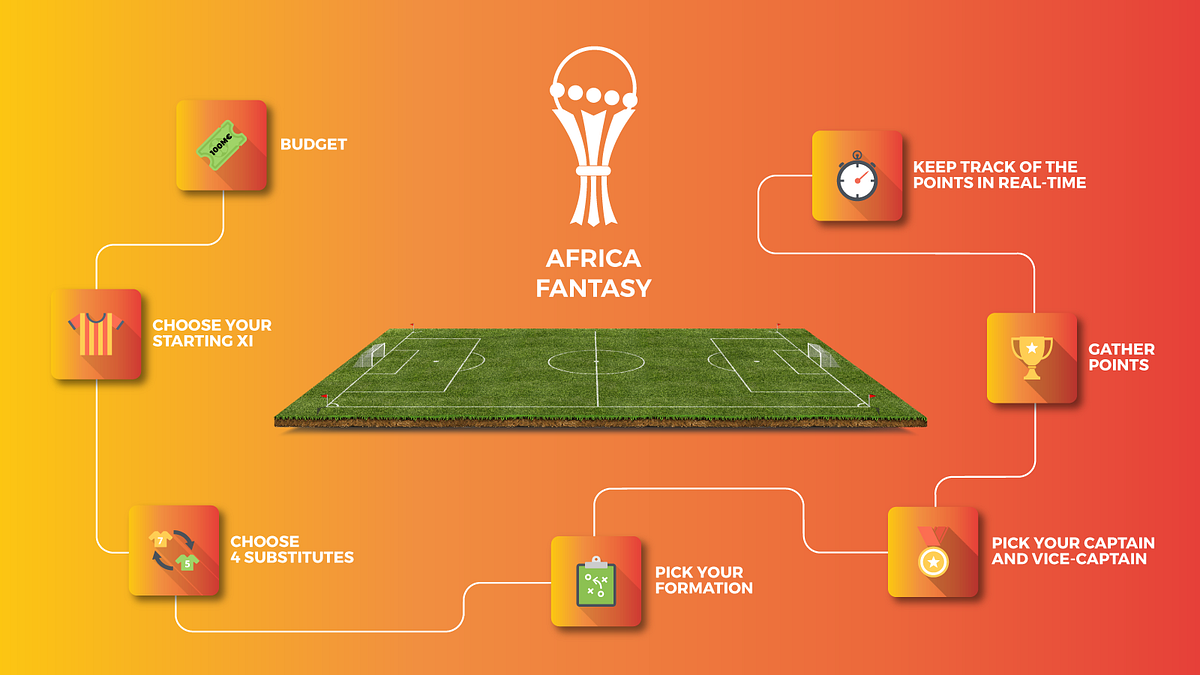

The kick-off for the 2019 AFCON is nearing. At RealFevr, you can already start building your Africa Fantasy squad! Before you dive into the competition, we thought it would be useful to give a quick round-up of the rules and basic strategy. This does not exempt you from reading the complete set of rules at RealFevr — consider yourself warned — but it should serve as a quick guide on how to play, if you’re new around here.

When you create your fantasy team, you’ll have a budget of 100M to build a squad with 2 goalkeeper, 5 defenders, 5 midfielders and 3 attackers. In the group stage and the round-of-16, you can have a maximum of three players from the same national team. In the quarter-finals the maximum rises to four, in the semi-finals it’s six and in the last gameweek (the final plus the 3rd and 4th place match) you can have up to 12 players from the same national team.

Tactics

After completing your squad of 15, you can prepare your starting XI for the first gameweek. You can use seven different tactics: 3–4–3, 3–5–2, 4–3–3, 4–4–2, 4–5–1, 5–4–1, 5–3–2. To change your tactical formation you can simply substitute someone from your starting XI with a player from the bench. If you’re in 4–4–2 and change a midfielder with an attacker, the team changes automatically to a 4–3–3. If you use manual substitutions (more on this below), you can change your tactics during the gameweek.

Captain and vice-captain

For captain and vice-captain you should pick the players that you believe will have the higher scores of the gameweek. Your captain’s score will be doubled, so the greater the outcome of his performance, the more you’ll benefit. If your captain doesn’t play in the gameweek, the vice-captain will have his points doubled; otherwise, the vice-captain has no benefit. If you use manual substitutions, you can change your captain during the gameweek. In this case, the best strategy is to give the armband to the player who plays first and keep changing it for every game, until you have a captain with a good score. This means that every player — not just the stars — is a potential captain when you use manual substitutions.

Substitutions

By default, your team will have the automatic substitutions turned on. With this option, if a player in your starting XI doesn’t play (not even 1 minute), he will be replaced by someone from the bench who has played. As mentioned before, if your captain doesn’t play, the vice-captain will have double points. The order in which the bench players will replace the ones that haven’t played is the order in which you organized your bench. This automatic changes will only take place at the end of the gameweek.

In the manual substitutions mode, you’re in charge of everything. To activate this mode, you just have to make a substitution or change of captain after the gameweek lock (1 hour before the first match). With manual mode on, you can change your captain in every game — but beware, once you change it, you can’t go back. You can give the armband only to players who are yet to play. You will also have the advantage of being able to take off the pitch someone who has already played. If you have someone with a disappointing score, you can replace him with someone from the bench. The substitute must be someone who hasn’t played yet. When using the manual substitutions, the best strategy is to leave on the bench the players whose matches will take place in the later days of the gameweek. You’ll give a chance to the ones who play first and replace them when they disappoint you. Beware: if a player is sent off with a red card, you won’t be able to replace him, nor can you remove the armband if he was your captain.

Transfers

For each new gameweek, you can transfer players to and from your squad. For gameweeks 2 and 3, the group stage, you can make two transfers. For gameweek 4, the round-of-16, you have unlimited free transfers. In the remaining gameweeks, you have 10 transfers. If you don’t use all your available transfers, you can have 2 more in the next gameweek. Every transfer you make beyond the free limit will result in a 4 points penalty on your score.

WildCard

You have access to a WildCard that you can use in whichever gameweek you choose. When active, the WildCard allows you to make unlimited transfers for the next gameweek. You can change all the squad as many times as you want until the market closes (1 hour before the first match of the gameweek). When the market for a gameweek closes, you can start making transfers for the next one. (However, this is a bad idea: you should wait for as long as you can, because of late injuries and other problems that arrive).

Scores and criteria

RealFevr’s World Fantasy has a total of 15 statistics scored. To see the complete list and how many points each action earns, please check the Rules page inside the competition. You’ll also find there the criteria we use, so you can understand who receives the clean-sheet points and what is considered an assist, etc.

Conclusion

With this information, you are in possession of a basic kit to start your adventure at the Africa Fantasy. Check our six Previews of all the groups in the AFCON (here are the links: A, B, C, D, E, F), they will help you pick your team. Then, head to RealFevr.com and start experimenting with your squad! You have unlimited transfers until the competition starts.

Bonus

If you want some more tips for the competition, check the video below, made by our partners of DZ Football:
Africa Fantasy: Group F preview

The defending Champion is a favorite to advance in this group


With the defending Champion and five-times winner Cameroon alongside four-times winner Ghana, Benin and Guinea-Bissau will have to be perfect to have a chance in this group. Check our preview of each of these nations below, it might give you some ideas for your Africa Fantasy team!

Cameroon

From Pot 1 comes the winners of last edition, Cameroon. With five titles, the Cameroonians will participate for the 19th time and they want the title again. They have good chances of advancing beyond the group stage.

Qualification

Cameroon qualified with the second place in Group B, with the some points as the group winners Morocco. With three victories, two draws and a defeat (against Morocco), Cameroon scored 6 goals and conceded 3. Choupo-Moting was the best scorer with 2 goals.

Key players

With lots of players coming from European leagues, Cameroon have some well-known names in their squad. Goalkeeper André Onana, striker Choupo-Moting and midfielders Kunde Malong, Bassogog or Clinton N’Jie might good choices for your team.

Squad

Goalkeepers: Onana, Ondoa, Kameni;
Defenders: Oyongo, Ngadeu, Yaya, Fai, Bong, Kana-Biyik, Dawa Tchakonte;
Midfielders: Kunde Malong, Bassogog, N’Jie, Anguissa, Boumal O., Kaptoum, Djoum, Mandjeck;
Attackers: Choupo-Moting, Bahoken, Toko, Tagueu, Zoua.


Ghana

From Pot 2 comes another former winner. Ghana won the AFCON four times, but the last title was in 1982, 37 years ago. They will play the tournament for the 22nd time, being the third nation with more presences.

Qualification

Ghana won the Group F of the qualifiers, which had Sierra Leone disqualified. So they played only four games, losing one to Kenya and winning the other three. They scored 8 goals and conceded only 1. Jordan Ayew and Dwamena were the best scorers, with 2 goals each, but Dwamena won’t be at the AFCON.

Key players

With veteran Asamoah Gyan leading the squad (he has 50 goals for Ghana), there’s good talent in the team: Thomas Partey, André Ayew, Jordan Ayew and Christian Atsu are all used to play in big stages.

Squad

Goalkeepers: Ofori, Annan, Zigi;
Defenders: Kasim, Lumor, Baba, Boye, J. Aidoo, Yiadom, Mensah, Attamah;
Midfielders: A. Ayew, Atsu, M. Wakaso, S. Owusu, Asamoah, Partey, Afriyie, Agyepong, K. Owusu;
Attackers: J. Ayew, A. Gyan, Caleb.


Benin

From Pot 3, Benin plays the AFCON for the 4th time, having never advanced beyond the group stage. Their chances of doing so this year are slim.

Qualification

Benin finished in second place in Group D, behind Algeria and ahead of Gambia and Togo. They won three matches, lost two and drew one, finishing with a negative goal difference of 5–6. Steve Mounié was the top scorer, with 2 goals.

Key players

Despite having lots of players in European Leagues, there’s no big names in this squad. Striker Steve Mounié or the veteran Stéphane Sèssegnon are your best choices.

Squad

Goalkeepers: Farnolle, Allagbé, Kakpo;
Defenders: Kiki, Imorou, Salomon, Adénon, Adilehou, Verdon, Fassinou, Barazé;
Midfielders: Sèssegnon, Djigla, Dossou, Tidjani, Soukou, Adéoti, Mama, Kossi, D’Almeida;
Attackers: Mounié, Poté, D. Sègbè.


Guinea-Bissau

Guinea-Bissau will play the AFCON for the second time in a row, after their debut two years ago. Their chances of advancing are slim.

Qualification

Guinea-Bissau won the Group K of the qualification, ahead of Namibia, Mozambique and Zambia. It was a very tight race, with the four teams winning two matches each. With three draws, Guinea-Bissau finished with 9 points, only 2 above the last placed Zambia. With an 8–7 on goal difference, Frédéric Mendy was the top scorer, with 3 goals.

Key players

With the majority of players coming from various tiers of Portuguese leagues, Guinea-Bissau have a modest team, without International experience. Winger Mama Baldé and striker Mendy, both in the top tier Portuguese League, are your safest bets from Guinea-Bissau.

Squad

Goalkeepers: Jonas Mendes, Rui Dabó, Ivanof;
Defenders: Juary, Mamadu, Nadjack, Nanú, Rudi, Marcelo Djaló, Tomás Dabó;
Midfielders: Mama Baldé, Piqueti, Toni Silva, Zezinho, Moreto, Pelé, Bura, Jorginho, Jaquité, Mané;
Attackers: Mendy, Mendes Jo., Romário.

Africa Fantasy: Group E preview

Tunisia are the top seeded nation in a group that can prove unpredictable


The 2004 AFCON winners Tunisia will face a group where they are the favorites, but it won’t be easy. With Mali, Mauritania and Angola completing the ensemble, every team has its hope to advance. Check our preview of each of these nations below, it might give you some ideas for your Africa Fantasy team!

Tunisia

In 2004, Tunisia won the AFCON for the first time in their history. This year, they’ll play the tournament for the 19th time. Despite being one of the most experienced African teams, they’re not among the favorites to win this year. But they are the favorites in this group.

Qualification

Tunisia did a great qualification, winning Group J ahead of Egypt. They won five games and lost only in Egypt, by 3–2. With only 4 goals conceded, the Tunisians scored 12, with Naïm Sliti emerging as the top scorer, with 4 goals.

Key players

Wahbi Kazri and Naïm Sliti, both from the French League, are the stars in a team that has other good players like Anice Badri and Taha Khenissi.

Squad

Goalkeepers: Ben Mustapha, Hassen, Ben Cherifia;
Defenders: Bronn, Meriah, Ben Mohamed, Dräger, Haddadi, Bedoui, Kechrida, Hnid;
Midfielders: Khazri, Sliti, Badri, Msakni, Srarfi, Sassi, Chaaleli, Aouadhi, Skhiri, Lamti;
Attackers: Khenissi, Chaouat.


Mali

From Pot 2 comes Mali, with their 11th participation. They never won the AFCON, but reached the final in 1972. Mali has good chances of advancing past the group stage, although the group is a bit unpredictable.

Qualification

In Group C of the qualifiers, Mali didn’t have trouble securing the top spot. Without losing a match, they drew both games against Burundi and won both games against Gabon and South Sudan. They conceded only 2 goals and scored 10, with Kalifa Coulibaly and Adama Traoré being the top scorers with 2 goals each.

Key players

Without a super-star in the squad, Mali has some interesting players. From the Portuguese League they have Moussa Marega and Abdoulaye Diaby. Midfielders Moussa Doumbia, Adama Traoré (from Orléans) and Adama “Noss” Traoré (from Cercle Brugge) are also ones to watch. And, of course, the striker Kalifa Coulibaly.

Squad

Goalkeepers: A. Kéïta, Djigui, Mounkoro;
Defenders: Fofana, F. Falaye, Massadio, Molla, Hamari, Kiki, Y. Koné;
Midfielders: Doumbia M., Diaby, Noss, Koïta, D. Samassékou, Traoré A., Lassana, Djenepo, A. Haidara, Cheick;
Attackers: Marega, Kalifa, Niane A.


Mauritania

Mauritania will play the AFCON for the first time in their history. Coming from Pot 3, their chances of advancing beyond the group stage are very slim.

Qualification

Mauritania came second in Group I of the qualifiers, behind Angola, who are also in this AFCON group. They lost away to Angola and Burkina Faso, but won the other four matches, including two against Botswana. With a goal difference of 7–6, the top scorer was Ismael Diakite, with 3.

Key players

Without any big name in their squad, your best bet is to go with striker Ismael Diakite if you must have someone from Mauritania. Bessam, Adama Ba or El Id Hacen are other cheap options for your midfield, with some international goals on their curricula.

Squad

Goalkeepers: Souley Diallo, Babacar D., Namori;
Defenders: Abdoul Ba, Abou Demba, Aly Abeid, B. N’Diaye, EM. Diaw, Sally Sarr, Thiam Abd., Diarra;
Midfielders: El Id Hacen, Adama Ba, Bessam, Coulibaly, Guidilèye D., Palaye, A. Diop, K. Camara, Y. Dellahi;
Attackers: I. Diakite, H. Tanji, Souleymane.


Angola

In their 8th participation, Angola comes from Pot 4 and will reunite with Mauritania, after they were in the same qualification group. Despite coming from Pot 4, Angola might have a better chance of advancing than Mauritania.

Qualification

Angola won the qualification Group I, ahead of Mauritania, Burkina Faso and Botswana. With two away losses, against Burkina Faso and Mauritania, they won the other four matches in the group, scoring 9 and conceding 6. The veteran Mateus was the top scorer, with 4 goals.

Key players

The Lazio center-back Bastos is the most renowned Angolan player. From the Portuguese League come three attackers capable of scoring lots of goals: Mateus, Gelson Dala and Wilson Eduardo. The winger Fredy can also cause problems for the opposing teams.

Squad

Goalkeepers: Landu, Tony Cabaça, Ndulo;
Defenders: Bastos, B. Gaspar, Dany Massunguna, Eddie, Buatu, Paízo, Wilson;
Midfielders: Fredy, Djalma, Evandro, Geraldo, Isaac, Macaia, Stélvio, Herenilson, Show;
Attackers: Wilson E., Gelson Dala, Mateus, Mabululu.

Africa Fantasy: Group D preview

This group has three previous AFCON winners!


Group D of the AFCON has in its line-up three former Champions! That’s right, only one team — Namibia — in this group has never won the AFCON title. The three others have won it: Ivory Coast twice and Morocco and South Africa once. Check our preview of each of these nations below, it might give you some ideas for your Africa Fantasy team!

Morocco

Morocco won the AFCON 33 years ago, in 1976, and will play the tournament for the 17th time. Coming from Pot 1, they have high chances of advancing, with a good lot of players with European experience.

Qualification

Morocco won the qualification Group B with 11 points, the same as second place Cameroon. The other teams were Malawi and Comoro Islands. With three victories, two draws and a defeat, the Moroccan side scored 8 goals and conceded 3. Hakim Ziyech was the top scorer, with 3 goals.

Key players

Hakim Ziyech is the main star of the Moroccan national team. But there are other well known players like defender Mehdi Benatia, goalkeeper Bounou, midfielder Boufal or striker En-Nesyri. The last three all play in Spanish La Liga.

Squad

Goalkeepers: Y. Bounou, M. El Kajoui, A. R. Tagnaouti;
Defenders: M. Benatia, A. Hakimi, M. da Costa, N. Mazraoui, Abdelhamid;
Midfielders: H. Ziyech, S. Boufal, N. Amrabat, Y. Belhanda, F. Fajr, K. El Ahmadi, Boussoufa, N. Dirar, O. Idrissi, R. Saïss, M. Bourabia, Y. Aït Bennasser;
Attackers: En-Nesyri, A. El Kaabi, K. Boutaïb.


Ivory Coast

From Pot 2 comes two-times Champion Ivory Coast. They won the trophy pretty recently, in 2015, are the second nation with most presences: this will be their 23rd time playing AFCON.

Qualification

Ivory Coast qualified with a second place in Group H, 1 point behind Guinea and ahead of Central African Republic and Rwanda. They won three games, drew two and lost one, scoring 12 goals and conceding 5. There’s no clear goal scorer, with four players scoring twice: Bailly, S. Doumbia, M. Cornet and J. Kodjia.

Key players

Eric Bailly, the Manchester United defender, is probably the best known Ivorian player today, but he will miss AFCON due to injury. Nevertheless, there’s plenty of talent in the squad: Aurier, Zaha, Cornet, Kessié, Seri, Pépé are some of the best the AFCON has to offer.

Squad

Goalkeepers: S. Gbohouo, Ali Badra, E. I. Tape;
Defenders: S. Aurier, S. Doumbia, W. Kanon, C. Comara, I. Traoré, M. Bagayoko, W. Coulibaly;
Midfielders: W. Zaha, M. Cornet, Max Gradel, F. Kessié, I. Sangaré, J. M. Seri, JP Gbamin, Serey Dié, V. Angban;
Attackers: N. Pépé, J. Kodjia, R. Assalé, W. Bony.


South Africa

From Pot 3 comes another former Champion: South Africa won the AFCON title in 1996. They’ll participate for 10th time but didn’t have much luck in the draw. With Morocco and Ivory Coast as favorites to advance, the South Africans need to outperform themselves.

Qualification

South Africa qualified without losing a single match, but came only second in Group E, behind Nigeria and ahead of Libya and Seychelles. With three victories and three draws, they managed to draw 0–0 with Seychelles, a team that got only 1 point and conceded 25 goals in 6 games! The South African goal difference was 11–2, with Percy Tau being the top scorer with 4 goals.

Key players

The majority of the South African team plays in their home country. There’s no big name in the squad, with the strikers Percy Tau and Lebo Mothiba being their top rated men.

Squad

Goalkeepers: D. Keet, B. Bvuma, R. Williams;
Defenders: Hlatshwayo, Mkhwanazi, S. Hlanti, D. Cardoso, I. Maela, Mphahlele, T. Mkhize;
Midfielders: T. Serero, T. Zwane, S. Vilakazi, D. Furman, L. Maboe, B. Zungu, H. Kekana, K. Mokotjo, T. Lorch, T. Mabunda;
Attackers: L. Mothiba, Percy Tau, L. Veldwijk.


Namibia

From Pot 4, Namibia plays the AFCON for the 3rd time. They never got beyond the Group Stage and this year their chances are also very slim.

Qualification

Namibia qualified with a second place in Group K. This was a very complicated group, because every team could win it. The final points of the four teams were: 9, 8, 8, 7 — only 2 points separating the winner from the last spot. They finished behind Guinea-Bissau and ahead of Mozambique (same points, but Namibia won both games against the Mozambican) and Zambia. Every team in the group conceded 7 goals, but Namibia was the one who scored less: only 5. Shalulile, with 2 goals, was the top scorer.

Key players

With almost all the squad playing in African leagues, there’s no obvious choices here. Go for attacking players like Shalulile or Hotho if you believe in Namibia’s chances.

Squad

Goalkeepers: Mbazuvara, L. Kazapua, Max Mbaeva;
Defenders: A. Gebhardt, D. Haoseb, L. Horaeb, R. Hanamub, C. Hambira, Kamberipa, R. Nyambe;
Midfielders: Deon Hotto, P. Shitembi, Stephanus, Ketjijere, A. Limbondi, Fredericks, J. Kamatuka, M. Starke, M. Papama;
Attackers: Shalulile, I. Gurirab, B. Shilongo, I. Keimuine.

Africa Fantasy: Group C preview

Senegal, Algeria, Kenya and Tanzania fight to advance in this group


With only its second participation, Tanzania looks like the underdog in a group with three teams fighting for the top 2 spots: Senegal, Algeria and Kenya. Check our preview of each of these nations below, it might give you some ideas for your Africa Fantasy team!

Senegal

Coming from Pot 1 we have Senegal, who have reached the final in 2002, losing to Cameroon. This is their 15th time reaching the Group Stage and they are one of the most experienced African football outlets. Senegal is one of the serious contenders to win the competition.

Qualification

Senegal breezed through their qualification group, with five wins and a draw, against Madagascar. The group wasn’t too complicated though: besides the second placed Madagascar there were Equatorial Guinea and Sudan. Senegal scored 12 goals and conceded only two! M’Baye Niang was the top scorer, with 3 goals.

Key players

The main star in the Senegal National Team is Liverpool’s Sadio Mané, but he didn’t score a single goal in the qualification stage. He is in good company, with great players like centre-back Kalidou Koulibaly and talented Keita Baldé, Ismaïla Sarr, Mbaye Diagne and M’Baye Niang.

Squad

Goalkeepers: A. Gomis, E. Mendy, A. Diallo;
Defenders: Koulibaly, Salif Sané, M. Wagué, P. A. Cissé, Y. Sabaly, L. Gassama, Saliou Ciss;
Midfielders: Sadio Mané, Keita Baldé, I. Sarr, S. Thioub, H. Saivet, Badou Ndiaye, C. Kouyaté, I. Gueye, A. N’Diaye, K. Diatta;
Attackers: M. Niang, M. Diagne, M. Konaté.


Algeria

From Pot 2 comes Algeria, who won the tile in 1990. This is their 18th time playing the AFCON and they arrive with legitimate aspirations to advance in this group.

Qualification

The Algerians won group D of the qualification, ahead of Benin, Gambia and Togo, with three victories, two draws and a defeat, agains Benin. They scored 9 goals and conceded 4, with Bounedjah being the top scorer, with 3 goals.

Key players

The English champion Riyad Mahrez, from Manchester City, is the Algerian big star. The midfield has other talented players like Brahimi, Feghouli and the youngster Bennacer.

Squad

Goalkeepers: M’Bolhi, Oukidja, Doukha;
Defenders: Mandi, Benlamri, Atal, Zeffane, Halliche, Bensebaini, Tahrat;
Midfielders: Mahrez, Brahimi, Feghouli, Ounas, Belaïli, Abeid, Boudaoui, Bennacer, Fares, Guédioura;
Attackers: Bounedjah, Slimani, Delort.


Kenya

Having never advanced beyond the Group Stage, Kenya will try again this year, on their 6th participation. The task isn’t easy, but if one of the two top contenders fails, Kenya is ready to take advantage.

Qualification

Kenya was in Group F of the qualification, which had Sierra Leone disqualified, so each team played only four matches. They won two, and had a draw and a defeat, finishing second place, behind Ghana and above Ethiopia. With four goals scored and one conceded, no one scored more than once for the Kenyans.

Key players

The main star in the team is Victor Wanyama, who plays for Tottenham in the Premier League. Michael Olunga is the expected goal scorer, with 15 goals in 32 games for the national team.

Squad

Goalkeepers: J. Oyemba, P. Matasi, F. Shikalo;
Defenders: Aboud Omar, Eric Ouma, J. Onyango, M. Mohammed, P. Otieno, B. Ochieng, D. Owino, J. Okumu;
Midfielders: E. Johana, Ayub Timbe, F. Kahata, J. Omolo, O. Ochieng, V. Wanyama, D. Odhiambo, I. González, Paul Were;
Attackers: M. Olunga, John Avire, M. Juma.


Tanzania

Almost 40 years after their first participation, in 1980, Tanzania are back at the AFCON. They’re chances of advancing in this group are very low, so they will play without pressure.

Qualification

Tanzania qualified through Group L, finishing second place behind Uganda and ahead of Lesotho and Cape Verde. Two victories, two draws and two defeats granted a spotted at AFCON. With a goal difference of 6–5, Samatta and Msuva were the highlights, with two goals each and three assists together.

Key players

Without a big name in their squad, and lots of players who haven’t left their home country, Mbwana Samatta and Simon Msuva are really you’re best bets, if you’re going to pick someone from Tanzania.

Squad

Goalkeepers: A. Manula, A. Kalambo, A. Mnata;
Defenders: A. Morris, E. Nyoni, K. Yondani, M. Hussein, Ally Mtoni, G. Michael, H. Ramadhan, V. Philipo;
Midfielders: S. Msuva, F. Mussa, Himid Mao, H. Yahya, F. Salum, F. Domayo, Yahya Zayd;
Attackers: M. Samatta, A. Mussa, John Bocco, R. Mandawa, Ulimwengu.

Liga NOS Virtual: As surpresas da temporada 2018–19

Estes foram os jogadores low cost que mais renderam na Liga NOS Virtual


Como é expectável numa fantasy league, muitos dos jogadores que mais pontuaram eram caros no nosso sistema de preços. Este sistema é feito com base no que é esperado dos jogadores, com base em factores como o seu desempenho em anos anteriores, a equipa que representam e o papel que ocupam dentro de campo. Como exemplo, Bruno Fernandes, o MVP da temporada, custava 11M no início da época — mais caro do que a grande maioria dos avançados da prova — e o seu valor terminou ainda mais elevado: 11.3M. É um caso em que a expectativa se cumpriu.

Houve outros casos em que a expectativa era elevada e acabaram por não ter o rendimento esperado a nível de fantasy. Três avançados que passaram algum tempo lesionados, como Jonas, Dost e Aboubakar, são bom exemplo disso. Mas este artigo é para falar de surpresas. Jogadores que tinham preços acessíveis no contexto das suas posições e que renderam muitos pontos de fantasy! Estabelecemos um máximo de 5M para guarda-redes e defesas e de 7M para médios e avançados — com base nos preços de final da competição. Comecemos pelos homens da baliza.

Guarda-redes


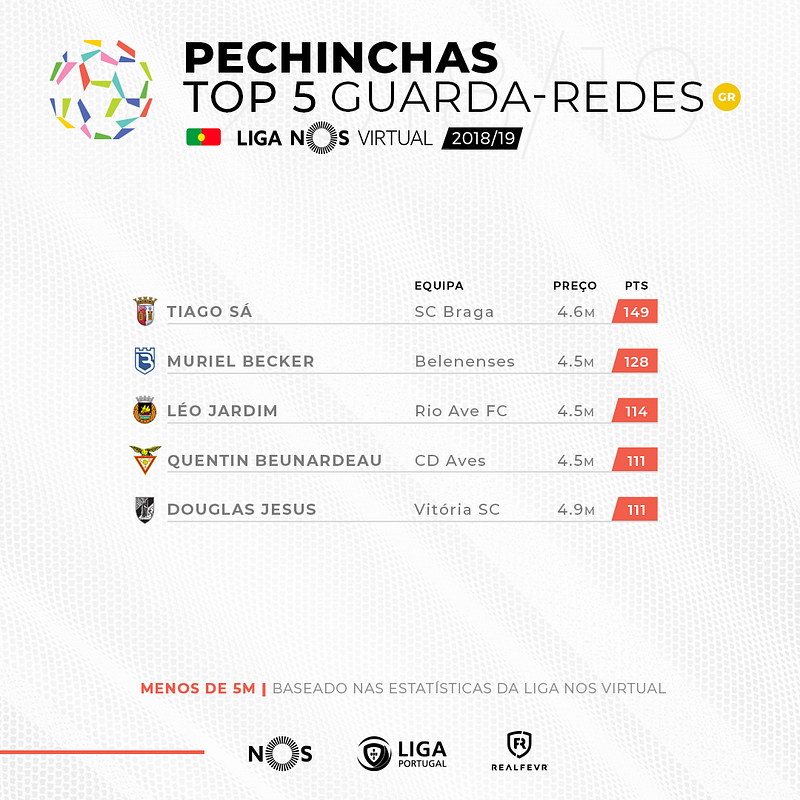
O bracarense Tiago Sá aproveitou da melhor forma as lesões de Marafona e Matheus para segurar a baliza dos minhotos e fazer desta a sua época de afirmação. Com um preço de 4.6M, era uma aposta segura. Seguem-se-lhe Muriel Becker, do Beleneses, Léo Jardim, do Rio Ave, Quentin Beunardeau, do Aves, e Douglas, do Vitória SC. Os dois últimos fizeram um bom número de jogos, mas não foram sempre titulares, o que valoriza ainda mais a sua presença neste Top.

Defesas


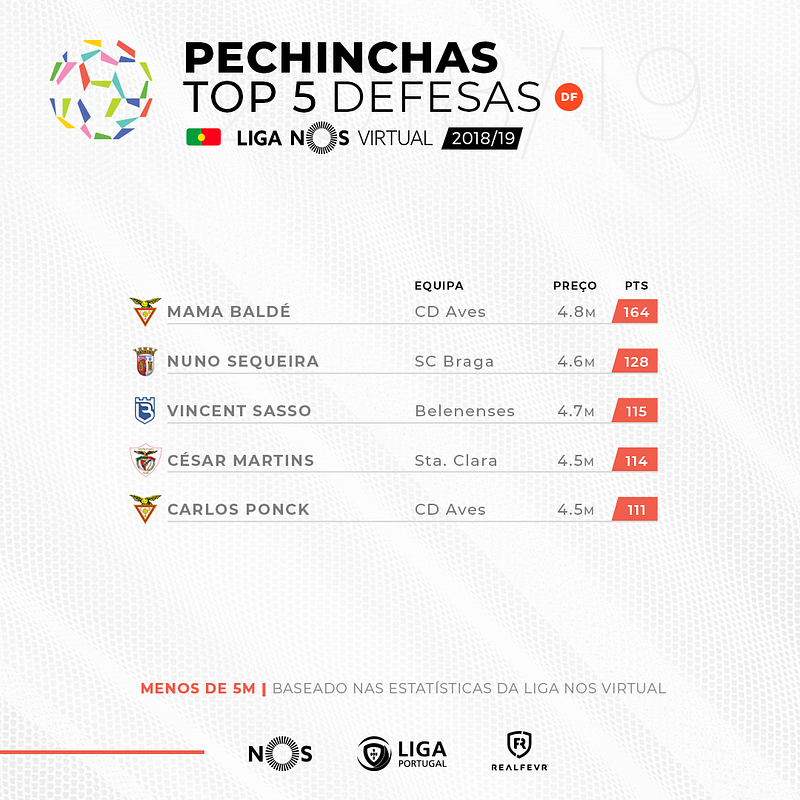
No Top 5 de “pechinchas” defensivas, o Aves tem dois representantes. Mama Baldé, que faz parte da Dream Team e do Top 20, e Carlos Ponck, na 5.ª posição. Nuno Sequeira, o lateral-esquerdo do Braga, aparece na 2.ª posição. Os restantes são todos centrais com veia goleadora: Vincent Sasso, do Belenenses, César Martins, do Sta. Clara, e o já referido Carlos Ponck.

Médios


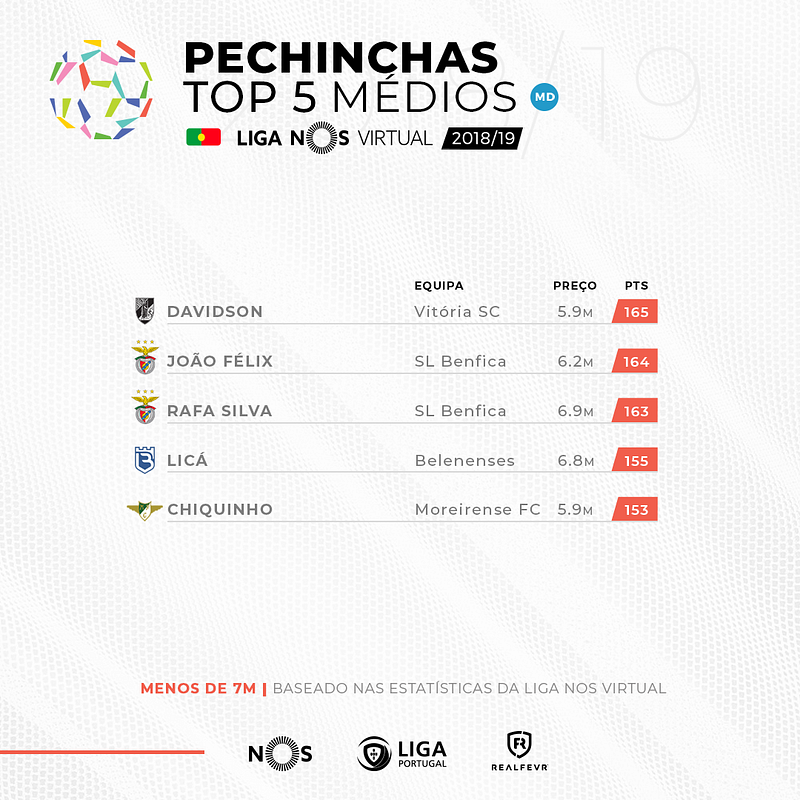
Os médios que aparecem nesta lista de “pechinchas” fazem todos parte do Top 20, pelo que não há aqui grandes surpresas. O Benfica coloca dois, João Félix e Rafa — ambos começaram a época menos bem cotados do que jogadores que se revelaram menos preponderantes, como Salvio ou Cervi. O líder destes médios abaixo dos 7M é Davidson, do Vitória SC. A seguir aos dois benfiquistas aparecem Licá, do Belenenses, e Chiquinho, do Moreirense, que foram fundamentais nas campanhas dos seus emblemas.

Avançados


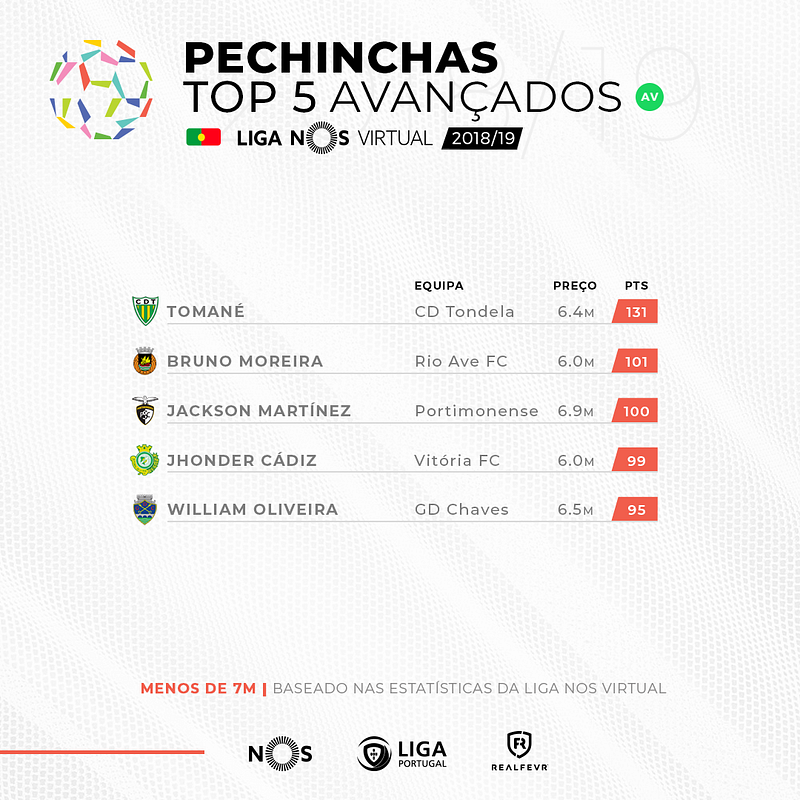
O Top dos melhores avançados abaixo dos 7M é mais uma prova de que a Liga NOS 18–19 não foi uma prova para atacantes. Nestes Tops por posição, só nos avançados aparecem jogadores abaixo dos 100 pontos. Tomané, do Tondela, é o destaque com 131 pontos. Os restantes estão separados por apenas seis pontos. Bruno Moreira, do Rio Ave, Jackson Martínez, do Portimonense, Jhonder Cádiz, do Vitória FC, e William Oliveira, do Chaves. O número de golos que marcaram é, também, modesto. Tomané é o único acima dos 10, com 12 golos. Moreira, Jackson e Jhonder fizeram 9 cada e William apenas 5!

Africa Fantasy: Group B preview

Group B has two nations making their debut in AFCON


The second group in AFCON has two of the three nations playing the tournament for the first time: Madagascar and Burundi. The top seeded team is the three times champions Nigeria. The fourth team in the group is Guinea. Check our preview of each of these nations below, it might give you some ideas for your Africa Fantasy team!

Nigeria

With three AFCON titles in their record, with the most recent in 2013, Nigeria is always a contender for the glory, with lots of players with European experience.

Qualification

Nigeria won the qualifier Group E, with four victories, a draw and a defeat. They came ahead of South Africa, Libya and Seychelles. Both the draw and the defeat were against South Africa. Nigeria scored 14 goals and conceded 6. Odion Ighalo, with 7 goals in 4 matches, was the top scorer of all the qualifier groups.

Key players

With players like Ighalo, Ndidi, Iwobi, Obi Mikel or Musa, it’s hard to pick a main star in the Nigerian squad. Keep an eye for the youngster Chukwueze, who’s only 20 years old, and plays for La Liga’s Villarreal.

Squad

Goalkeepers: F. Uzoho, I. Ezenwa, D. Akpeyi;
Defenders: K. Omeruo, Ola Aina, A. Shehu, L. Balogun, W. Ekong, C. Awaziem, J. Collins;
Midfielders: Alex Iwobi, H. Onyekuru, M. Simon, O. Etebo, Chukwueze, Obi Mikel, John Ogu, S. Kalu, W. Ndidi;
Attackers: O. Ighalo, Ahmed Musa, V. Osimhen, P. Onuachu.


Guinea

Going to their 12th presence in the AFCON, Guinea come from Pot 2 of the draw and are favorites to go through with Nigeria.

Qualification

Guinea won the Group H of the qualifiers without losing a single match. With three victories and three draws, they came ahead of Ivory Coast, Central African Republic and Rwanda. With an 8–4 goal difference, François Kamano, with 2 goals, was their best scorer.

Key Players

The Champions League winner Naby Keïta is the main star in the Guinean squad, with Bordeaux’s Kamano and Napoli’s Diawara having also an important role.

Squad

Goalkeepers: Aly Keita, I. Koné, N. Yattara;
Defenders: I. Sylla, B. Sankoh, E. Seka, F. Camara, J. Jeanvier, M. Dyrestam, O. Sidibé, S. Falette;
Midfielders: Naby Keïta, F. Kamano, A. Diawara, I. Traoré, I. Cissé, M. Camara, B. Fofana;
Attackers: M. Yattara, I. Sylla, José Kanté, Sory Kaba, B. Koita.


Madagascar

Coming from Pot 3 of the draw, Madagascar is one of the two debutants in this Group. Their chances of going through are slim, but they’ll try an upset.

Qualification

Madagascar qualified with a second place in group A of the qualifiers, behind Senegal and ahead of Equatorial Guinea and Sudan. They won three games, drew one and lost two, with the same amount of goals for and against: eight. Madagascar had a previous qualification round, against São Tomé and Príncipe, winning home and away. They had three players with 3 goals each in the qualifier rounds.

Key players

No big stars in this team. Andriatsima, Andriamahitsinoro and Voavy were the top scorers, so you can go with these if you believe in Madagascar.

Squad

Goalkeepers: J. D. Randrianasolo, M. Adrien, I. Dabo;
Defenders: J. Morel, J. Mombris, Razakanantenaina, R. Métanire, T. Fontaine, M. Gervais, Rambeloson;
Midfielders: Andriamahitsinoro, P. Voavy, A. Abel, I. Amada, L. Nomenjanahary, R. Raveloson, A. Andrianarimanana, D. Caloin, Ilaimaharitra, Rakotoharimalala, Romario Baggio;
Attackers: F. Andriatsima, W. Gros.


Burundi

Another debutant in this group, Burundi have a tough task ahead of them. No one expects big things, which might play in their favor.

Qualification

With a second place behind Mali in Group C, Burundi qualified without losing, despite winning only two matches and drawing the other four. The two victories were against South Sudan. Fiston Abdul-Razak was the top scorer for Burundi, with 6 goals.

Key players

Besides the goal scorer Abdul-Razak, the other striker Saido Berahino is probably the squad’s star and best known player. He plays in England, for Stoke City.

Squad

Goalkeepers: J. Nahimana, Ndikumana, M. Arakaza;
Defenders: Nshimirimana, Nsabiyumwa, Nizigiyimana, O. Ngandu, O. Moussa;
Midfielders: C. Amissi, Bigirimana, S. Nahimana, Duhayindavyi, H. Shabani, Nduwarugira, E. Kamsoba, Sabumukama, F. Mustapha, M. Amissi, P. Kwizera;
Attackers: S. Berahino, F. Abdul-Razak, L. Mavugo, Ndikumana.

Africa Fantasy: Group A preview

Two former AFCON Champions clash in the first group


The first group of 2019’s AFCON has the host nation of Egypt as the favorites to advance to the next stage. Fighting for a spot are also former champion (twice) DR Congo, Uganda and Zimbabwe. Check our preview of each of these nations below, it might give you some ideas for your Africa Fantasy team!

Egypt

The pharaohs are the hosts of this year’s AFCON. They are the nation with most appearances in the tournament, playing it for the 24th time, and also the one with the most titles: seven! Will the home advantage lead Salah and co. to its 8th title?

Qualification

The Egyptians were in Group J of the qualifiers and they didn’t win it. They came 2nd, 3 points behind group winners Tunisia, and above Niger and Swaziland. They lost the first game, against Tunisia, and the last one, surprisingly, against Niger. The other four matches were won. With 15 goals scored and 5 conceded, the Egyptians had in Salah, with 4 goals, its best scorer.

Key players

There’s no escaping it: UCL winner, with Liverpool, Mohamed Salah is Egypt’s star and, probably, the best African player today. Trézéguet is another winger you should keep under your radar.

Squad

Goalkeepers: M. Elshenawy, El-Shenawy, M. Gennesh;
Defenders: Elmohamady, A. Hegazy, A. Ashraf, M. Hamdy, Omar Gaber, A. Mansour, B. El Mohamady, M. Alaa;
Midfielders: M. Salah, Trézéguet, Abdallah, Amr Warda, M. Elneny, T. Hamed, Ali Ghazal, Nabil Emad, W. Soliman;
Attackers: M. Mohsen, Kouka, Ahmed Ali.


DR Congo

The Democratic Republic of Congo has two AFCON titles on their records, but the most recent one isn’t recent at all: 45 years have passed since DR Congo won the tournament, in 1974. They were drawn into this group from Pot 2, so they have a chance of progressing.

Qualification

In a group with Zimbabwe, Liberia and Congo (the other one), DR Congo came only second, behind Zimbabwe. They won only two games, draw three and lost just one, against group winners Zimbabwe. They went 8–6 in goal difference, with Bakambu being the top scorer, with three goals.

Key players

Cédric Bakambu is the main character in DR Congo’s squad. The former Villarreal player is now in China, playing for Beijing Guoan, where he continues to score goals for life.

Squad

Goalkeepers: Matampi, Mossi, P. Mandanda;
Defenders: Luyindama, Masuaku, Bokadi, Ngonda, Ungenda, Mbemba, Djuma, Mpeko, Tisserand;
Midfielders: Y. Bolasie, M’Poku, Mputu, C. Akolo, Mulumbu, Maghoma, Meschak, Moke;
Attackers: C. Bakambu, Assombalonga, J. Bolingi.


Uganda

Participating for the 7th time in the tournament, Uganda have legitimate hopes of advancing after the good results in the qualifiers.

Qualification

Uganda won the Group L of the qualifiers, with four wins, a draw and a defeat. They came ahead of Tanzania, Lesotho and Cape Verde, scoring seven goals and conceding three. They drew against Tanzania at home, and lost by 3–0 away against the same team. Farouk Miya was Uganda’s top scorer, with three goals.

Key players

Without a big star in the squad, and not many players playing in Europe, goalkeeper Dennis Onyango is the voice of command in the team. The top scorer Farouk Miya, who’s only 19 years old, is Uganda’s big hope.

Squad

Goalkeepers: D. Onyango, J. Salim, Odongkara;
Defenders: G. Walsimbi, B. Mugabi, I. Muleme, J. Ochaya, M. Jjuuko, N. A. Wadada, R. Mukiibi, T. D. Awany;
Midfielders: F. Miya, L. Kizito, T. Lwanga, A. Lumala, Kateregga, H. Wasswa, K. Aucho, Kyambadde, M. Azira;
Attackers: E. Okwi, D. Nsibambi, P. H. Kaddu.


Zimbabwe

Zimbabwe will meet DR Congo again, after facing them in the qualifier Group G, which gives them hope of progressing. This is their 4th presence in the AFCON group stage.

Qualification

Despite coming from Pot 4, Zimbabwe actually won its qualifier group, finishing ahead of DR Congo, who were placed in Pot 2 and drawn also to this group. With three victories, two draws and a defeat, Zimbabwe scored 9 goals and conceded 4. Their only loss was against Liberia, who failed to qualify. Knowledge Musona, with 5 goals in 5 appearances, was the team’s best scorer.

Key players

Marvelous Nakamba and Knowledge Musona, both playing in the Belgium League, are Uganda’s top rated players. Le Havre’s Tino Kadewere is one the young players who could have an impact.

Squad

Goalkeepers: E. Sibanda, E. Chipezeze, G. Chigova;
Defenders: T. Hadebe, T. Darikwa, A. Mudimu, D. Lunga, J. Dzingai, M. Munetsi, Pfumbidzai;
Midfielders: K. Musona, K. Billiat, O. Karuru, Chawapiwa, D. Phiri, M. Nakamba, K. Mahachi, T. Kitinyu, T. Kamusoko;
Attackers: E. Rusike, N. Mushekwi, K. Mutizwa, T. Kadewere.

Liga NOS Virtual: Os reis das estatísticas

Vê aqui vários Tops de estatísticas individuais da época 18–19


Agora que já esmiuçámos o que havia a esmiuçar em termos de pontuações totais (MVP e Dream Team, os Melhores da Época e as Surpresas), é altura de olharmos para algumas estatísticas individuais e ver quem se destacou. Começamos por uma que é essencial para ganhar jogos: rematar à baliza.

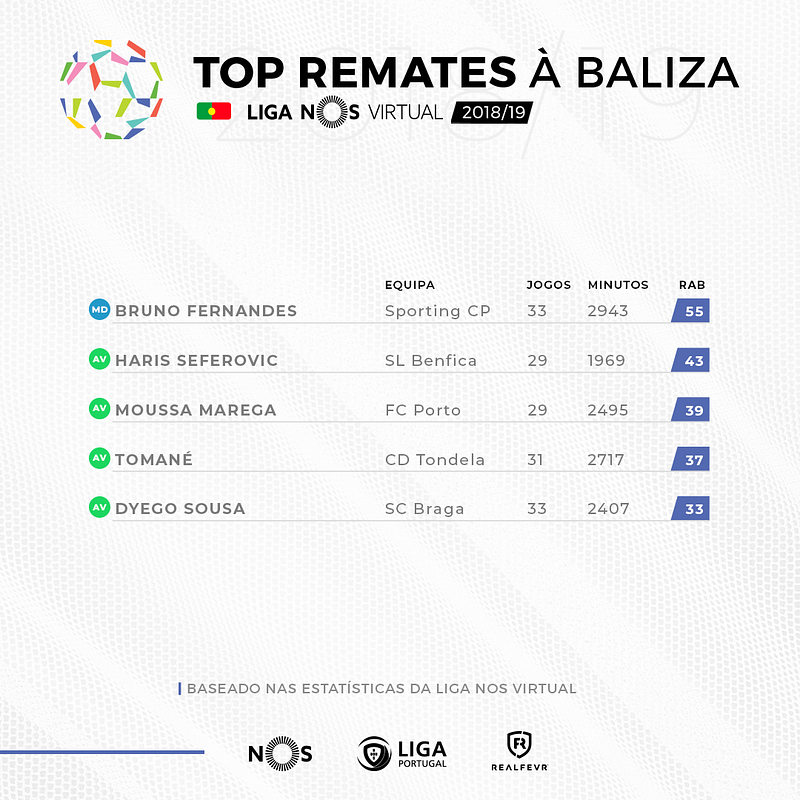
Remates à baliza


Aqui temos mais uma prova da época sensacional de Bruno Fernandes. Numa lista dominada, como seria de esperar, por avançados, o jogador com mais remates à baliza é um médio. Bruno Fernandes fez 55 remates enquadrados! Na lista seguem-se quatro atacantes. Seferovic, o melhor marcador da Liga, fez 43 remates à baliza. A lista completa-se com o dragão Marega, o tondelense Tomané e o bracarense Dyego Sousa.

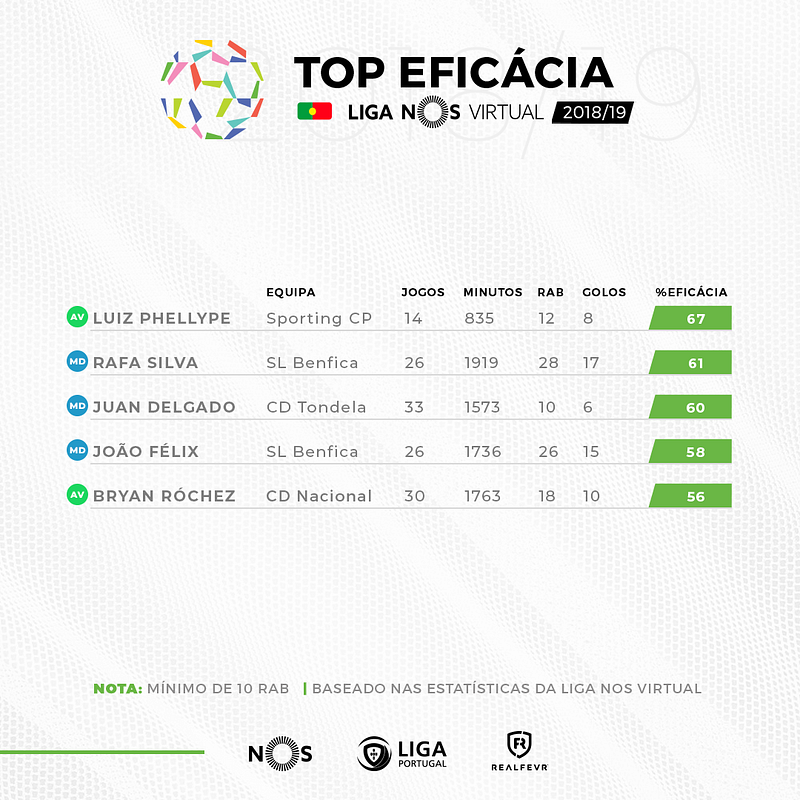
Eficácia


Mas rematar muito não é sinónimo de ser muito eficaz. Fomos a fazer as contas para saber quem tinha a maior percentagem de golos em relação aos remates enquadrados. Alguns defesas alcançam os 100%, mas são jogadores com 1 ou 2 remates à baliza. Estabelecemos um mínimo de 10 remates enquadrados para esta estatística. Assim, o reforço de Inverno do Sporting Luiz Phellype é quem domina, com 67% de eficácia (8G/12RAB). Segue-se uma sequência de três médios, com dois benfiquistas — Rafa e Félix — e Juan Delgado, do Tondela. A lista encerra-se com um despromovido: Bryan Róchez, do Nacional, conseguiu 56% de eficácia em 18 remates à baliza.

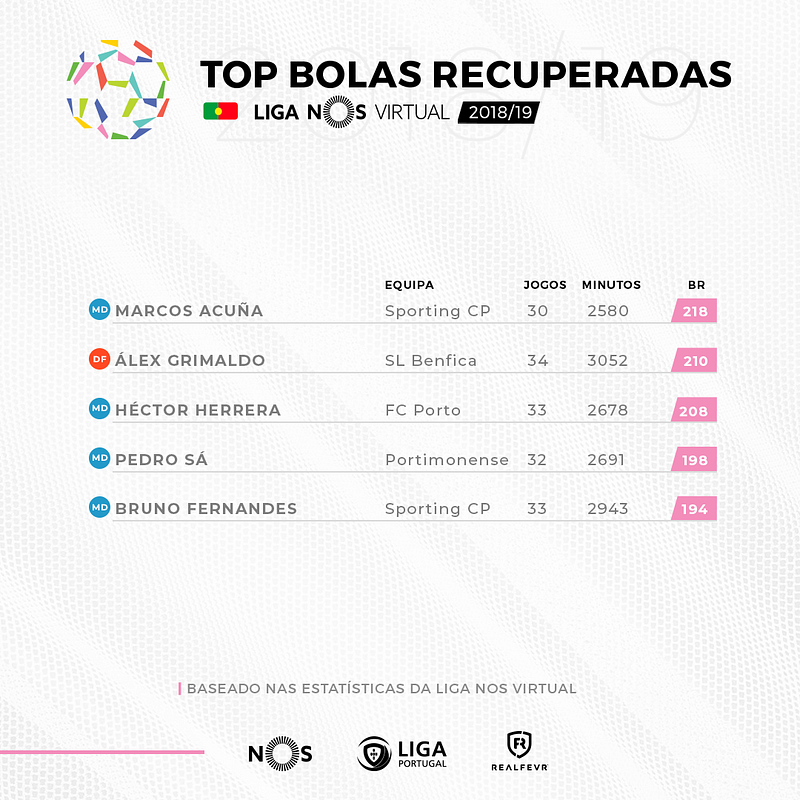
Bolas recuperadas


Olhemos agora para estatísticas mais defensivas, começando pelas bolas recuperadas. No Top 5 de recuperadores de bolas há um defesa, mas quem reina são os médios, que são quatro. O líder é o sportinguista Marcos Acuña, com 218 bolas recuperadas. O pódio completa-se com os três grandes: depois de Acuña vem Grimaldo, o único defesa, e depois Herrera. O quarto é Pedro Sá, do Portimonense, e a fechar o Top temos Bruno Fernandes, o MVP da época que também se evidenciou neste capítulo.

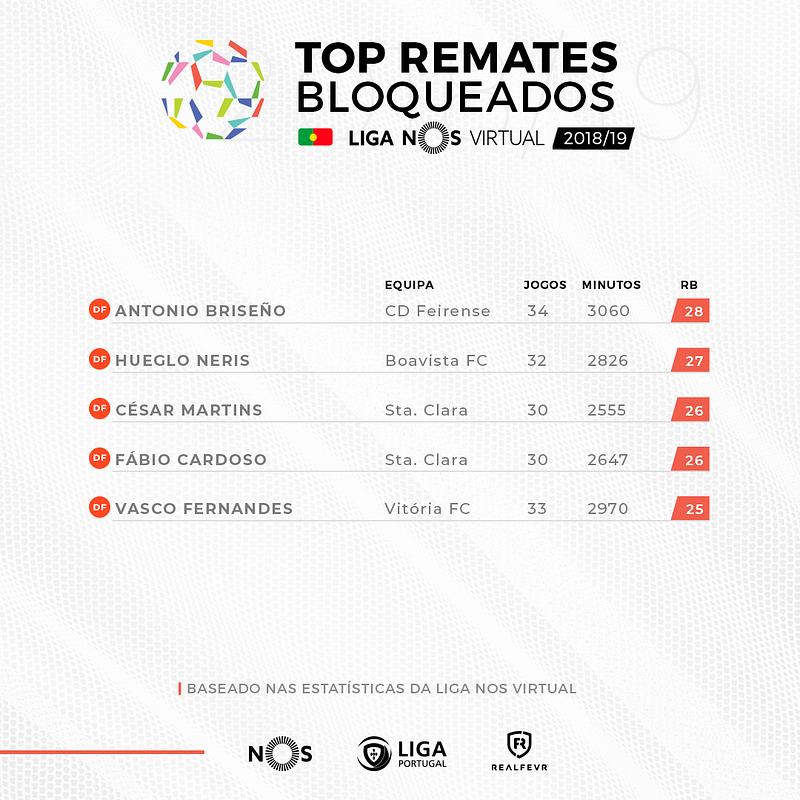
Remates bloqueados


Aqui só há defesas. Como era esperado, bloquear muitos remates só é possível quando se permite muitos remates aos adversários. Daí que os clubes representados nesta lista sejam os que são. Briseño, do último classificado Feirense, foi o rei dos remates bloqueados, com 28. Segue Neris, do Boavista, dois do Sta. Clara, César e Fábio Cardoso, e, por fim, o capitão do Vitória FC, Vasco Fernandes. São estes os cinco que mais boladas levaram e, em alguns casos, deram o corpo para evitar golos.

Defesas do guarda-redes


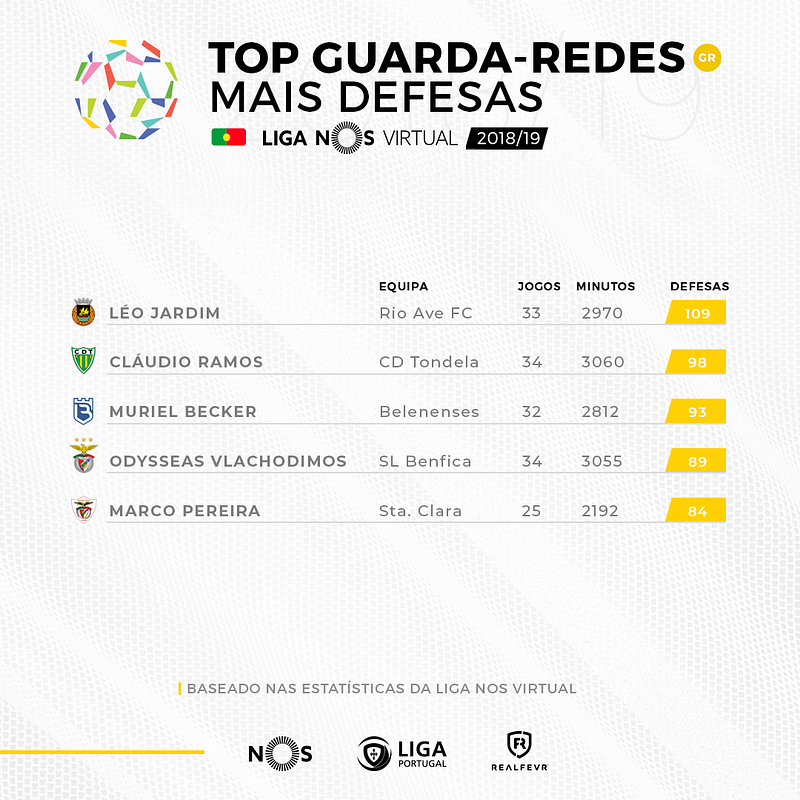
A última estatística individual para que olhamos é a das defesas dos guarda-redes. Aqui, o rei foi Léo Jardim, do Rio Ave, uma das boas surpresas da temporada. Seguem-se Cláudio Ramos, do Tondela, Muriel Becker, do Belenenses, Odysseas Vlachodimos, do Benfica, e Marco Pereira, do Sta. Clara. Este último tem números impressionantes: tem apenas 25 jogos — o segundo com menos é Muriel, com 32 — e mesmo assim somou 84 defesas! Com os 9 jogos que falhou, talvez tivesse chegado ao topo da lista.

Italy Fantasy: o balanço final da época 2018–19

Chegou ao fim o primeiro ano de Italy Fantasy na RealFevr. Vamos a contas.


A época desportiva 2018–19 arrancou com a bomba de que Cristiano Ronaldo se mudava do Real Madrid para a Juventus. Como aqui na RealFevr ninguém queria perder o craque de vista, fizemos um esforço extra para trazer a Italy Fantasy ao leque de competições oferecidas.

Agora que a Serie A chegou ao fim, chegou a hora de fazer um pequeno balanço. O campeão, sem surpresas, foi a Juventus, pelo 8.º ano consecutivo! Quanto ao Cristiano, apesar de uma excelente temporada, não foi o mais pontuado. Mas não ficou longe! Comecemos, então, pelo MVP da época:


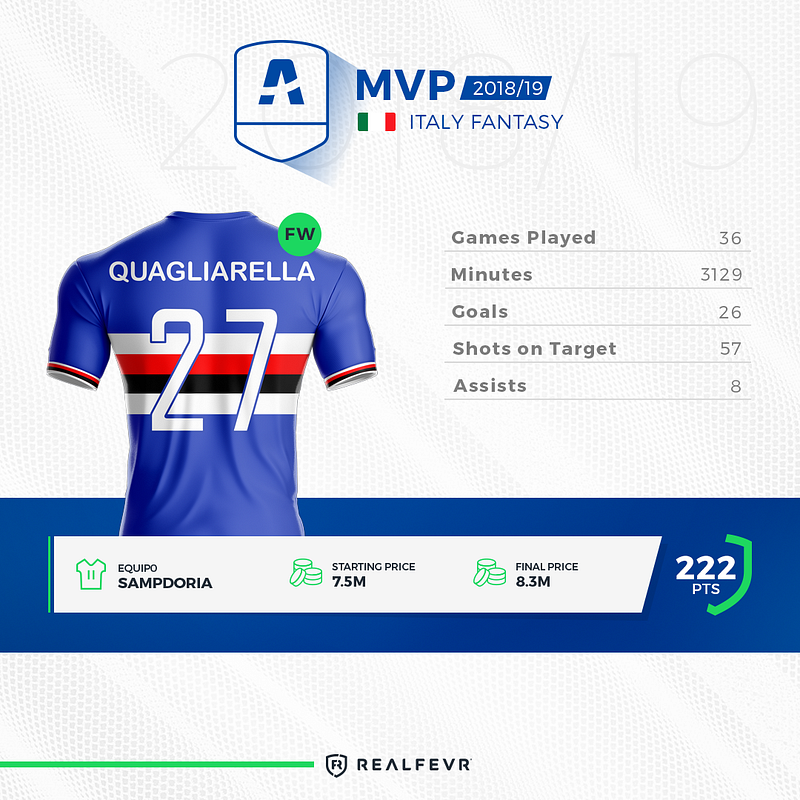
Se achavam que o Cristiano começava a acusar a idade, então tomem lá. Fabio Quagliarella tem 36 anos — é dois anos mais velho que Cristiano Ronaldo! — e é o grande MVP da Italy Fantasy. O veterano atacante da Sampdoria, que terminou a época no 9.º lugar, fez 26 golos (quase metade dos golos da equipa: 60) e 8 assistências, em 36 partidas. Números impressionantes, num campeonato que sempre soube valorizar a longevidade dos seus atletas.

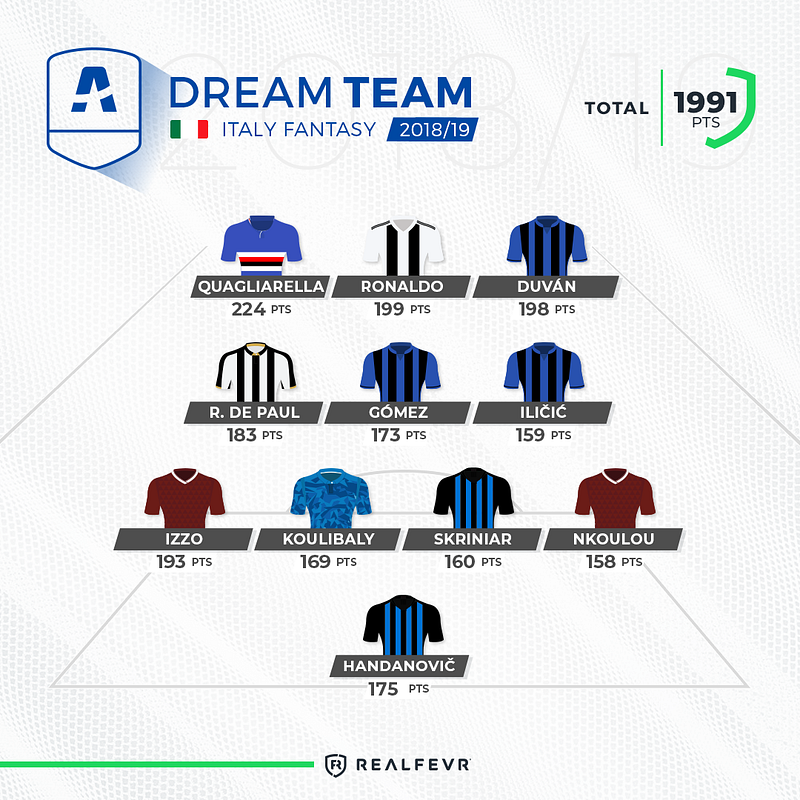
Como não podia deixar de ser, o Cristiano faz parte da Dream Team da época. Mas se a Juventus venceu a competição sem surpresas, a Dream Team traz algumas. Desde logo, porque Cristiano é mesmo o único representante do campeão.


Num 4–3–3 em que os três avançados são os três melhores jogadores da prova, a equipa em maior destaque é a Atalanta, com três representantes. A equipa de Bérgamo terminou num fantástico 3.º lugar, garantindo lugar na Champions League. O Torino e o Inter são os destaques seguintes, com dois atletas, numa equipa que se completa com um representante de Sampdoria, Juventus, Udinese e Napoli.

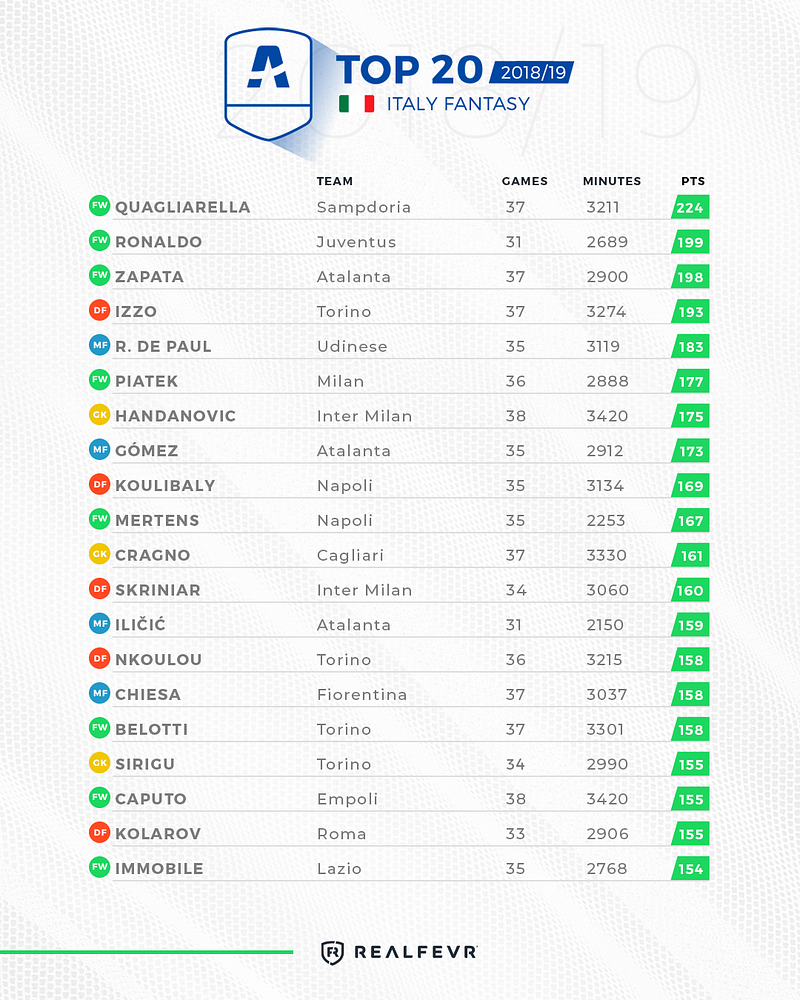
Para terminar este balanço final, trazemos-te o Top 20 da Italy Fantasy:


Com três avançados no Top 3, foram mesmo os atacantes que mais se evidenciaram: há oito neste Top 20. Depois vêm os defesas, que são cinco, depois quatro médios e três guarda-redes.

Em termos de equipas, há grande equilíbrio, com 13 equipas representadas! O Torino é quem domina, com quatro, depois a Atalanta com três, e Napoli e Inter com dois. Os restantes clubes com jogadores neste Top 20 são: Sampdoria, Juventus, Udinese, Milan, Cagliari, Fiorentina, Empoli, Roma e Lazio.

Design a site like this with WordPress.com
Iniciar